

AUTOMOS: Automation of Sterile Mosquito Mass Rearing Procedures
The primary objective of this project is to make large-scale Sterile Insect Technique (SIT) programs against Aedes mosquitoes economically viable.
The core innovation lies in the development of an automated and scalable rearing system that integrates advanced automation and robotic technologies to manage larval seeding, collection, and precise larval diet dispensing.
A key breakthrough is an adaptive pupal sex-sorting device that employs Artificial Intelligence (AI) algorithms and computer vision to dynamically adjust size thresholds, ensuring accurate batch separation. Additionally, automated adult cages are being designed with an integrated egg collection system that prevents escapes, addressing critical containment challenges.
This approach aims to overcome the bottlenecks of manual methods, achieving an estimated labor cost reduction of over 80%.
The project also encompasses the development of a comprehensive IoT-based monitoring infrastructure that automatically gathers massive amounts of data from all production stages, storing it in structured databases for subsequent analysis. This enables full process traceability and data-driven optimization.
This project was fully funded by the Spanish Centre for Technological Development and Innovation (CDTI) under the NEOTEC 2023 program.

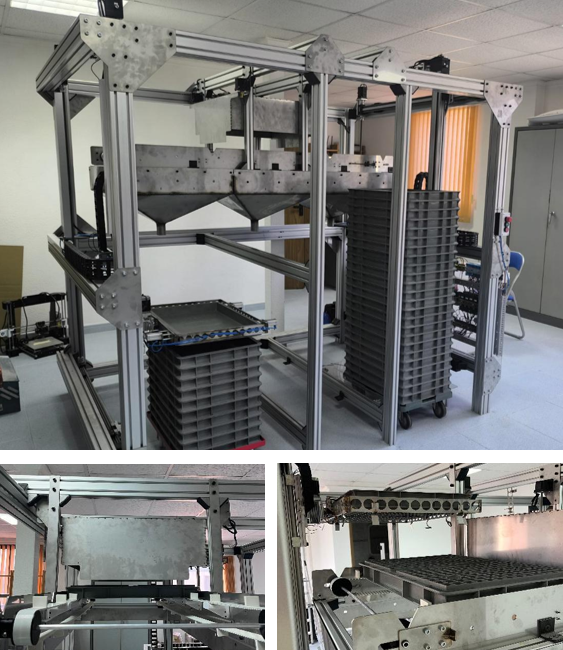
Automatic Mass Rearing System
Cicindela has developped a robotic station to process larval rearing trays automatically.
The larval tray processing station uses inexpensive euronorm trays as opposed to the large trays proposed by the IAEA.
Every tray is processed individually (unstaking, tilting, washing and re-stacking), reducing labor cost and improving the quality and yield of the sex sorting.
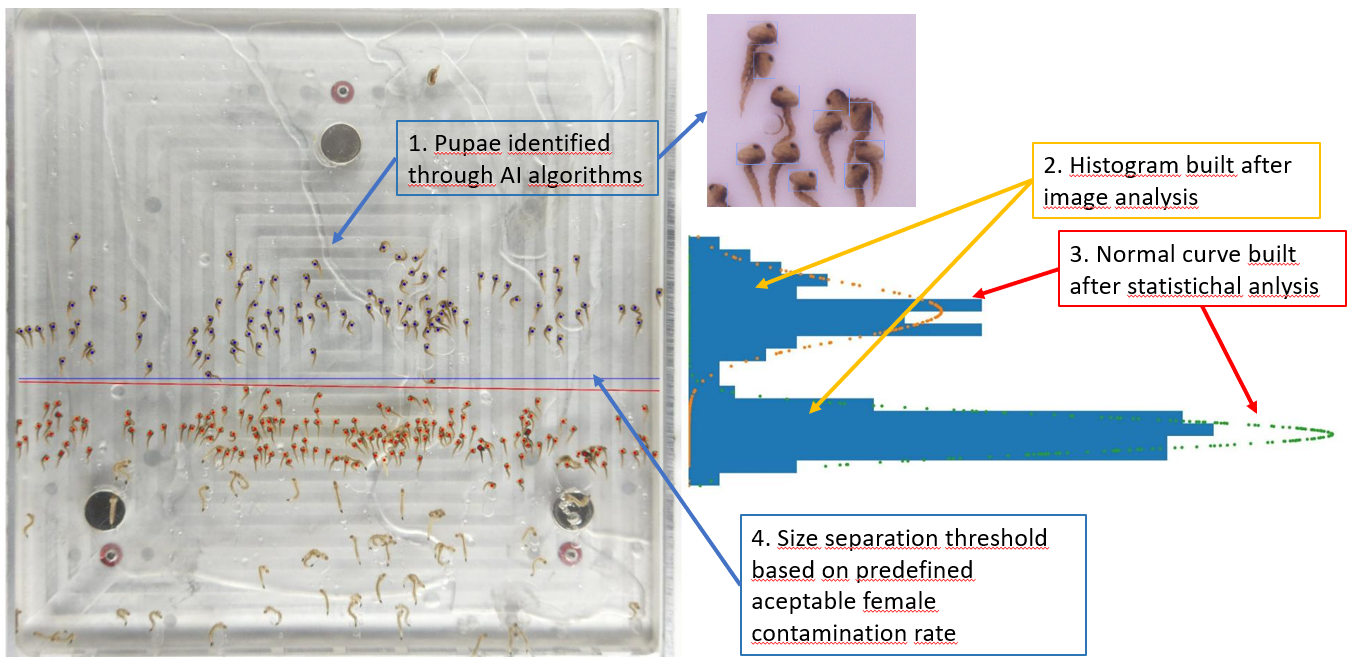
Smart Aedes Pupae Sex Sorter (SAPSS)
The intelligent Aedes pupae classifier automates sex separation by leveraging the sexual size dimorphism present in Aedes species, such as Ae. aegypti or Ae. albopictus, where male pupae are approximately 15–20% smaller than females.
This patented device is designed to classify particles ranging from 1.0 to 1.2 mm in diameter. The core mechanism is housed within a sealed inner cavity, through which a stream of water carrying the pupae flows.
Classification occurs in the adjustable space formed between a fixed transparent front plate and a mobile floating plate. This mobile plate’s position and angle are precisely controlled in three dimensions by a system of actuators and magnetic attraction, allowing for adjustments with sub-micron precision and millesimal degree resolution.
A high-resolution optical camera captures images of the pupae as they flow. AI algorithms, specifically based on convolutional neural networks, analyze these images in real-time to identify each pupa, determine its morphology and position, and generate a statistical histogram of the batch size distribution. The software then calculates the optimal separation threshold based on the user-defined acceptable female contamination rate, automatically adjusting the plate position to allow smaller male pupae to pass through while retaining the larger females